
Thursday, November 26th, 2026
now browsing by day
When the Run Club Arrives and Your Cafe Breakfast Has to Deliver
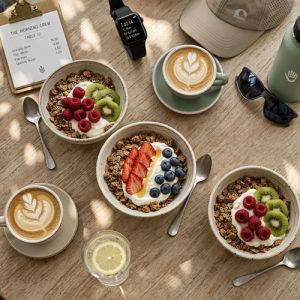
A running group walks into your cafe at 7:45 on a Wednesday morning. Fifteen people, give or take. They’re warm, they’re loud, they want coffee, and they want to sit together and eat. This is going to happen every week.
Run clubs attached to cafes are turning up across Australia. Some are organised by external operators who pair group runs with cafe stops for coffee and breakfast. Others are cafe-led, with the venue itself organising the run and the post-run meal. The format varies, but the service occasion is the same: a group arriving together, ordering within a tight window, and wanting to eat at roughly the same time. That occasion has its own operational shape.
This article looks at how your kitchen stays ahead of a weekly run club breakfast rather than chasing it, and why the answer is mostly about what happens before the group walks in.
How should a cafe set its breakfast menu for a run club?
Fifteen people ordering from a full breakfast menu at once can bury a small kitchen. But handing everyone the same plate turns breakfast into a refuelling stop, and the whole reason people stay after a run is the social part.
The middle ground is a short menu agreed with the run organiser in advance. Three or four items that your kitchen can prep for and execute close together. A granola and yoghurt bowl. Toast with eggs. Maybe a third option that already sits on your regular menu and doesn’t add a new prep stream.
A group this size will usually include a few people who are dairy-free, gluten-free or vegan, and a short menu with nothing for them breaks the point of everyone eating together. A plant-based yoghurt prepped alongside the dairy one, and gluten-free bread sliced and ready cover most of it without adding items. The granola bowl adapts most easily. Swap the yoghurt and the rest of the bowl can stay as it is, as long as the granola is one the whole table can eat.
The organiser doesn’t need to collect individual orders ahead of time. They just need to confirm approximate numbers and let the group know what’s available when they arrive.
What does a cafe kitchen prep before a group breakfast?
You know the group is coming and roughly how many. That’s an advantage few breakfast services have, and the useful thing to do with it is move all the preparation forward so that only the finishing steps happen after the group walks in.
Fruit prepped. Bread sliced. Yoghurt ready to spoon. None of this is cooking. It’s mise en place, done in the quieter window before the group arrives.
Set the tables too. Push them together before the group arrives and put jugs of water and glasses out. After a run, the first thing people want is water, not coffee, and having it already on the table meets that need without anyone queuing at the counter. It also buys the barista a few minutes.
The distinction between prepped and pre-made matters. Nobody wants a bowl of yoghurt and granola that’s been sitting for twenty minutes, absorbing moisture. Nobody wants eggs held under a lamp. Granola goes onto yoghurt, eggs go into water, toast goes down. But the gap between order and plate is compressed because nothing upstream is missing.
How does a cafe coordinate coffee and food for a group table?
This is a coordination problem that often goes unnoticed until you’re in the middle of it. In normal service, coffees go out ahead of food, one customer at a time, and the gap between the two is fine. With a group ordering together, the barista pulling fifteen coffees in sequence means the last person is waiting eight or ten minutes for theirs. Meanwhile food is either sitting or hasn’t started.
There’s no single correct answer here, and the right approach depends on staffing and layout. Some cafes split the labour, one person on machine and one on food, so both streams run in parallel. Some start coffees while the group is still sitting down and sorting out food orders. If it’s a regular group, the organiser might collect a rough coffee order on the run so the machine can start working the moment people walk in.
Whatever the setup, a run club gives you one advantage of its own. The group arrives together, but not to the second. Runners finish in pace groups, so the faster ones are usually through the door a few minutes ahead of the back of the pack. It’s still one table and one service, but that spread is time the cafe can use. Take the first wave’s orders as soon as they sit down, get their coffees started, and the machine is already working through the order by the time the rest arrive. Ask the organiser how the group usually splits, so the kitchen knows what’s coming and when.
What matters is the table’s experience: everyone eating and drinking at roughly the same time, rather than half the group finished before the other half has been served.
What makes a weekly run club breakfast sustainable for a cafe?
The first week is the hardest. After that, your kitchen knows the numbers, knows the menu, knows the timing. Prep becomes routine. The organiser knows what to tell the group. The group knows what to expect.
A weekly run club that reliably fills fifteen seats on a quiet weekday morning is good trade. The work involved in servicing it well is mostly front-loaded: agreeing the menu, establishing the prep routine, working out the coffee timing. Once that’s in place, you’re running a small, predictable, pre-communicated group service rather than reacting to a surprise rush.
Payment belongs on that list. Fifteen people settling separate bills at the counter at 8:40 creates a queue that blocks your regular walk-in trade just as the morning picks up. Taking payment at the point of ordering, or agreeing a single tab with the organiser, settles it before it becomes a problem.
Why does the granola bowl matter on a run club menu?
On a group order, the cooked plates all queue for the same stove. The granola bowl doesn’t join that queue. Its finishing step is assembly, so whoever has a free pair of hands can put it together, and it can go out to the first group while the eggs for the rest of the table are still in the water. Each one ordered takes a plate out of that queue.
That only helps if people order it. A granola bowl that reads as the dutiful option, the one people choose when they’re being good, gets ordered by two people and the kitchen carries everyone else. One that people actually want can take a third of the table or more off the stove. A bowl this simple has nothing to hide behind, so whether people want it comes down to the granola. Good granola turns a plain bowl of yoghurt and fruit into something people choose after a run.
On a group menu the granola has a second job. It’s the one part of the bowl that stays the same in every version. The yoghurt changes for anyone who’s dairy-free, and the granola doesn’t. If it’s vegan and made without nuts, like Mulberry Tree Super Crunch Granola, one tub covers the table, and every bowl is built the same way. If it isn’t, the simplest item on the menu turns into two.
If that’s the bowl you want on your run club menu, Mulberry Tree supplies bulk granola for cafes and foodservice.
This article was reproduced on this site with permission from operafoods.com.au the “Foodservice Granola Supplier”.
See original article:- When the Run Club Arrives and Your Cafe Breakfast Has to Deliver