
How Seasonal Fruit Gives Hotel Breakfast Granola a Sense of Place
Your guests have already chosen to be somewhere specific. They’re in wine country or on the coast or in a town known for its orchards. They arrived because the place itself was the draw. And then they come down to breakfast and find sliced rockmelon, portion-pack yoghurt and cereal dispensers that could belong to any hotel in the country. Nothing about the meal connects to where they slept.
Dinner gets attention. If your hotel is in a food region, the dinner menu probably already tells a provenance story. Breakfast rarely gets the same thinking, even though it’s the meal almost every guest eats and the last impression before checkout. For a guest who came to experience a region, a generic breakfast is a missed beat.
The fix is not an elaborate regional tasting menu at 7am. A simple seasonal fruit pairing can give your guest a sense of time and place just as effectively.
This article works through building a seasonal fruit and granola feature for your hotel breakfast buffet, from why the fruit matters through to the granola that makes it work every morning.
Why does seasonal fruit matter for hotel breakfast granola?
Seasonal fruit matters because it connects the meal to where your guest is and when they’re there. A hotel in northern Victoria serving ripe white nectarines in January may be offering fruit picked an hour’s drive away. That proximity is the strongest version of the story, but it is not the only one. Even a city hotel sourcing through a distributor can put seasonal Australian peaches on the buffet and serve something that belongs to this week, this climate, this part of the world.
Your guest doesn’t need to know the name of the grower. They need to bite into a peach that tastes like summer. That is the difference between a fruit platter assembled from whatever’s available and a breakfast that reflects a season.
How do you make hotel breakfast granola a buffet feature?
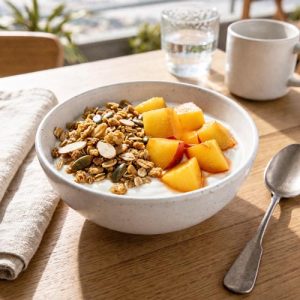
Start with the bowl itself. White nectarines over natural yoghurt, a handful of granola clustered on top. Three components, nothing hidden under anything else. The fruit is ripe enough to have some give, the yoghurt is cold, the granola is dry and crunchy against both. Good ingredients doing very little is what makes it work at breakfast.
Now give it a place on your buffet. Set the seasonal bowl or station apart from the standard cereal dispensers and the mixed fruit platter. Not on separate furniture, just in a clearly defined area. A small label names what’s there: “Summer peaches with natural yoghurt and granola,” or, if you know your supplier, “Goulburn Valley nectarines with yoghurt and Mulberry Tree granola.” Either version works. The first says this fruit is seasonal. The second says this fruit is from here.
Lay the components out separately and guests assemble their own, with less waste. Plate it and it becomes a dish. Both work within your existing buffet, and nothing else needs to change. One addition to the cold buffet, rotating with whatever fruit is at its best that week, is enough to shift the meal from generic to grounded.
How far should you go with local sourcing claims?
The instinct to claim local sourcing is strong, but the story only works if the claim is true. If you’re in a food region (the Barossa, the Hunter Valley, the Mornington Peninsula) you may genuinely be sourcing stone fruit or berries from a nearby growing district. If so, say it. A line on a breakfast card connecting the fruit to its region is the cleanest way to give breakfast the same sense of place that your dinner menu already has.
You may source through a distributor, and the fruit will arrive as Australian stone fruit without a specific farm or region attached. That’s still a story worth telling, just a simpler one. “Seasonal Australian peaches” says you’re paying attention to what’s ripe. It says more than an undifferentiated fruit platter, and it doesn’t ask you to guarantee something your supply chain can’t support.
What undercuts the whole exercise is fruit that contradicts the claim. Unripe nectarines, or stone fruit in winter, or berries that clearly haven’t come from anywhere nearby. The seasonal pairing only works if the fruit is genuinely good right now. When it’s not, when the season is between crops or the supply is poor, take the feature off the buffet until the fruit is worth featuring again. That honesty is part of what makes it credible.
What granola works for a seasonal breakfast bowl?
The fruit changes. That’s the whole point. It follows the season and your region. The granola is what stays. It needs to be there every morning doing the same job: giving the bowl its crunch, its sweetness, its base texture against whatever’s ripe.
Mulberry Tree’s Roasted Almond Crunch works because it doesn’t compete with the fruit. The oat clusters are toasted and firm. They hold up against yoghurt without going soft in the first few minutes on a buffet. Whole roasted almonds give it weight. It’s lightly sweet rather than honeyed, so it sits well under tart apricots or ripe peaches without fighting them. The granola isn’t the star of the bowl. The seasonal fruit is. But without the right granola underneath, there’s no bowl to speak of.
Mulberry Tree supplies Roasted Almond Crunch in bulk catering packs, delivered direct or through your distributor. If you’d like to try the format, request a sample from our hotel granola supplier page.
This article was reproduced on this site with permission from operafoods.com.au the “Wholesale Granola Supplier”.
See original article:- How Seasonal Fruit Gives Hotel Breakfast Granola a Sense of Place
Comments are Closed