
Sunday, November 15th, 2026
now browsing by day
How Bulk Granola for Acai Bowls Improves Your Self-Serve Margins
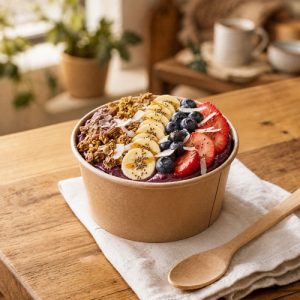
In a standard cafe, a granola topping is part of a fixed price bowl. You decide how much goes on, the cost is built into the menu price, and the customer never thinks about it. Self-serve acai flips that arrangement. The customer assembles the bowl, the bowl goes on a scale, and every ingredient is sold by weight. Granola isn’t a fixed cost topping any more but a priced component in a system your customer controls.
That shift turns granola from a cost you absorb into an ingredient that actively works for your margin, but only if the product is good enough to earn its place at the station.
This article looks at the customer behaviour that creates that opportunity, the economics that make it work, and what a granola actually needs to deliver in a cold, wet bowl.
How do customers choose toppings at a self-serve acai station
Watch a self-serve acai station for twenty minutes and a pattern becomes obvious. Customers tend to layer in a predictable sequence: base first, then fruit, then something crunchy, then a drizzle or sauce. Some people pile fruit high and skip the crunch, others go straight for the nut butter, but the general shape holds.
Granola tends to arrive at the point where the bowl starts looking finished. A bare acai base with fruit on top still looks incomplete. Add a scattering of granola and the bowl suddenly looks like a meal. That moment matters, because it’s often when customers stop adding. A bowl with good granola coverage doesn’t tend to attract a fifth or sixth topping the way a bowl of plain base and fruit does.
Granola is the ingredient that completes the bowl, and in a weigh and pay format, that matters commercially.
Why is bulk granola for acai bowls a high margin topping
In a weigh and pay model, every topping has two commercial characteristics: its cost per gram to you, and the weight it adds to the bowl that the customer is paying for. Those two numbers don’t move together.
Fresh fruit is moderate on cost but heavy, and even a few slices of banana or a scoop of mango adds significant weight to the scale. Nut butters and chocolate sauces are expensive per gram and dense, so even a small drizzle registers. Granola is light relative to the volume it takes up in the bowl. A generous handful, enough to cover the surface and give every spoonful some crunch, adds comparatively little to the final weight on the scale.
Granola is the rare ingredient where your customer’s instinct and your margin profile align. Customers reach for it because it makes the bowl look and feel substantial. It takes up visual and textural space without loading weight onto the ticket. And its cost per gram sits below most of the other toppings at the station, from fresh fruit through to nut butters and premium extras like acai drizzle or specialty seeds.
If the granola is good enough that customers actually want it, the economics of the format work in your favour.
What makes a good bulk granola for acai bowls
Not all granola performs the same way in a self-serve environment. What works on a retail shelf doesn’t necessarily work in a cold, wet bowl at a topping station.
Cluster size is the first one. Granola that’s too fine, broken down into loose oats and crumbs, doesn’t read as a topping. Customers skip it or take very little, because it looks like debris rather than an ingredient. Clusters that hold their shape look intentional. They give the customer something to pick up with a spoon, and they signal quality in a way that matters at the moment of self-serve choice.
Hold is the second. Acai is cold and wet, and granola that turns soft on contact stops doing the job that makes it commercially useful. The crunch is what customers reach for. Without it, granola becomes filler with no eating quality, and customers learn to skip it.
And then there’s the eating experience across the whole bowl. A self-serve acai bowl is only as good as its worst spoonful. If the granola clusters are too large, some bites are all crunch and no fruit. If they’re too small, the crunch disappears. The right cluster size means the granola distributes evenly enough that each spoonful has a bit of everything, base and fruit and crunch, without the customer having to think about it.
Bulk granola for acai bowls from Mulberry Tree
If you’re running a weigh and pay format, granola is a bulk ingredient. It arrives in catering quantities, gets decanted into a station container, and is judged entirely on how it performs in the bowl, not on its retail packaging or its branding on a supermarket shelf.
Our catering granola is designed for this format, built to hold its crunch on a frozen base and packed in bulk for high turnover service. If you’re running a self-serve station and want to see how it performs at yours, see our Granola for Acai and Smoothie Bars page for product detail and ordering.
This article was reproduced on this site with permission from operafoods.com.au the “Breakfast Cereal for Independent Grocers Suppliers”.
See original article:- How Bulk Granola for Acai Bowls Improves Your Self-Serve Margins