
March, 2026
now browsing by month
How to Design a Customisable Acai Bowl Menu for Your Cafe
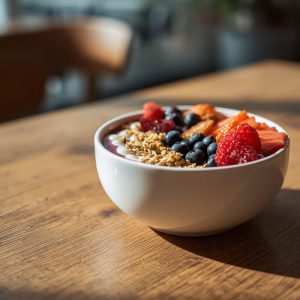
Designing a customisable acai bowl menu for your cafe is really a question of where you put the variation. Put it in the wrong place, and you fragment your prep, multiply your supplier relationships, and slow your line. Put it in the right place, and your kitchen runs cleanly while customers feel like they have genuine options.
The right place is the toppings. The frozen acai base does not change. That is not a constraint to work around; it is the decision that makes everything else possible. Standardise at the one point that is hardest to vary, and you open up genuine choice at the four points where it is easy: granola, fruit, extras, and drizzle.
What granola works best for acai bowls in a cafe?
Crunchy granola works best for acai bowls, and this matters more than any other topping decision. An acai bowl is thick, cold, and dense. Without real texture at the top, it reads as a smoothie in a bowl, and a smoothie in a bowl is not what anyone ordered.
In practice, that means genuine cluster formation and low moisture absorption. Fine granola can soften within two minutes of hitting a cold base, so you want clusters that hold for the length of service.
Source from a dedicated producer rather than a grocery range. Consistency of cluster size and bake level varies enormously between products, and that inconsistency shows up directly in the bowl.
How many topping options should I offer on an acai bowl menu?
The answer from menu psychology is three to five per category. Fewer than three feels restrictive. More than five tips customers into decision fatigue, which shows up not as a moment of quiet contemplation but as hesitation at the counter, repeated questions, and a queue starting to back up behind them. The satisfaction problem and the throughput problem are the same issue.
The structure across all four categories looks like this.
Granola
Each option on your menu needs to do something genuinely different, not just taste slightly different. Most cafes will run two or three of these, not all five.
Roasted Almond Crunch — the house default we’d recommend as your starting point. Oat-based, vegan, low sugar, and the cluster structure holds well against a frozen base.
Maple Nut Crunch — a natural second option for cafes that want a more distinctly flavoured alternative, with its award-winning maple profile.
Super Crunch — covers nut-free requirements without sacrificing texture.
Maple Nut Crunch Gluten Free — for customers where gluten is an issue.
Cinnamon Keto — for menus targeting a more specific dietary niche.
Fruit
Four to five options are enough. The visual appeal of an acai bowl does a lot of the selling, so prioritise fruit that photographs well against a purple base and holds up once sliced. Colour contrast, freshness, and stability during service matter as much as flavour.
Seasonality is your friend here. What is peaking in quality from your supplier is usually what looks best in the bowl. Build one rotating seasonal slot into your menu structure, and you can swap it week to week without reprinting or retraining.
The one thing to avoid is anything that oxidises quickly once prepped. It adds pressure during service and undermines the finished product if timing slips.
Extras
This is where the menu gets character, and where it can unravel if you are not careful. Four options is the ceiling. Beyond that, a clean customisation system starts to feel like a toppings bar, which is a harder thing to execute and a different product category entirely.
The best extras menus have a point of view. Rather than stocking a bit of everything, choose four options that reflect your cafe’s positioning and hold that line. A bowl that feels considered is more compelling than one that feels exhaustive.
Coconut flakes, chia seeds, cacao nibs, nut butters, and bee pollen are all common choices. Hemp seeds and toasted pepitas work well for cafes leaning into a more savoury or wholefood direction. The combination matters less than the coherence.
Drizzle
Two options are all you need. Drizzle is a finishing touch, not a decision point, and treating it as anything more than that adds complexity without adding value.
Honey is the obvious default. For a second option, something with a bit more character works well. Tahini photographs exceptionally and differentiates from the generic honey-only approach. A good nut butter drizzle is another option for cafes that want something richer. The choice should feel like a deliberate finish, not an afterthought.
Fourteen to sixteen items across the four categories give customers genuine variety without turning the ordering process into a project.
How do I set a house default for acai bowl toppings?
The house default is the bowl your staff makes when a customer orders without specifying. It should be your best bowl, not your cheapest one. It represents the product, and most first-time customers will order it.
Set the default by working backwards from what looks good, travels well on a tray, and tastes balanced. It should cover all four categories, use ingredients that are stable and reliably available, and photograph cleanly. You can adjust based on your own suppliers and margins, but the logic holds.
There is a secondary reason to take the default seriously. Most customers accept it without question, because changing it requires a deliberate decision, and most people are not in the habit of interrogating a menu item they have never tried. That means your default does real commercial work: it determines which ingredients move, which combinations get photographed and shared, and which bowl defines your acai offering in the minds of first-time visitors. The same principle applies across any customisable bowl format, and the mechanics of balancing customer choice with cafe efficiency are worth understanding in their own right.
Communicate the default clearly on the menu. “House acai: served with X, Y, Z” sets expectations and cuts the most common source of friction at the counter before it starts.
The house default also gives you a reference point for pricing. Once you have established its cost, you can decide whether customisation is included in the base price or whether add-ons carry a surcharge. Both models work; what matters is that the pricing logic is visible and consistent.
Acai bowl house combinations: the case for pre-designed options
Not every customer wants to make choices. This is especially true during morning rush, when regulars want to order fast, and new customers do not want to experiment with their breakfast.
Named combinations solve this by deciding for them. Three is usually enough: a classic, something more indulgent, and a lighter option. Name them something memorable rather than descriptive. “The Northside” or “Summer Standard” does not need to tell you what is in it, because the ingredients are listed underneath. It just needs to be easy to order and easy to remember.
The combinations also do commercial work. They are where you put your higher-margin or harder-to-move ingredients. If you have committed to bee pollen as an extra and customers are not ordering it, put it in a named combination and let it move through that channel instead.
Keep the combinations on the menu alongside the customisation system, not as a replacement for it. Some customers want both: they order a named combination and swap one ingredient. That is an easy request to accommodate, and it signals that the menu is genuinely flexible rather than just appearing to be.
The structure holds whether you are running a high-volume breakfast spot or a smaller cafe with a tight menu. Get the framework right, and the kitchen runs predictably, customers order confidently, and the bowl sells itself. Granola is the ingredient that does the most work and the one most worth getting right. Opera Foods stocks a crunchy granola range developed specifically for cafe use, with the cluster consistency and bake level that holds against a frozen base. Browse the crunchy granola range.
This article was reproduced on this site with permission from operafoods.com.au the “Wholesale Café Suppliers”.
See original article:- How to Design a Customisable Acai Bowl Menu for Your Cafe